


He keeps showing up. The chalk fades. The panels get replaced. But the pattern spreads anyway, until the real permanence isn’t the paper, it’s the recognition.
Christopher said:
Keith keeps showing up day after day in the subway, filling those blank canvases in a space he wasn’t meant to claim, knowing none of it will last. But he’s leaning on something else. He’s leaning on recognition to do the lasting. And over time, it starts to happen. People begin to recognize the drawings first, then the spot, then him.
Eric said:
Yes.
Repetition becomes recognition. Recognition becomes identity.
At first it’s just a guy with chalk. Then it’s, “Oh. It’s him.” Then it’s, “That’s his.”
The chalk doesn’t last. The paper doesn’t last. But the pattern does.
He kept showing up until the city started expecting him.
That’s the permanence.
Not a wall that survives.
A memory that spreads.
Christopher said:
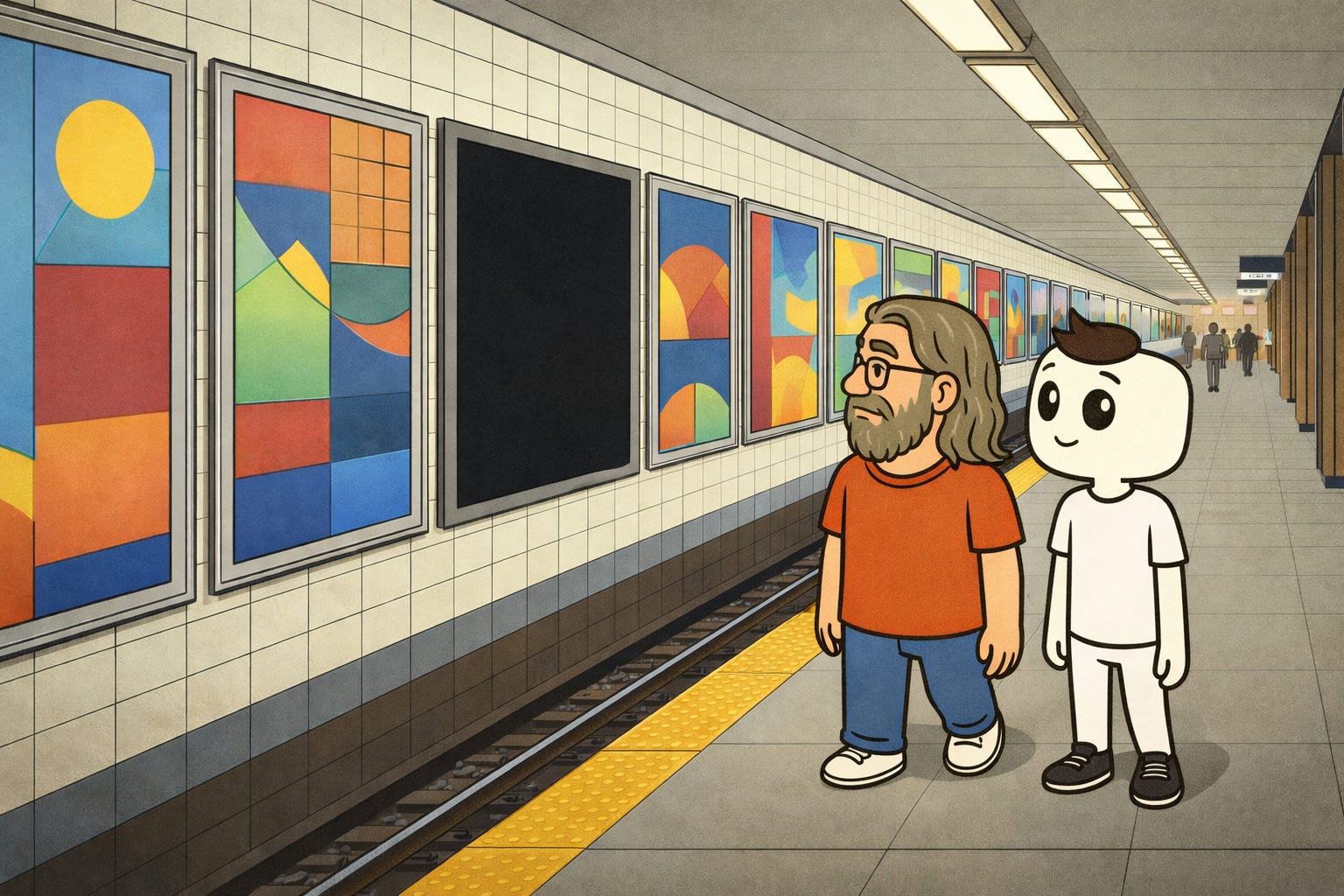
Picture a New York subway swallowing you whole, ads screaming from every surface. And in that environment, ordinary people are on their way to work, to love, to whatever comes next, tired or lit up, lonely or held, every kind of person moving through the same tunnel and experiencing that art in different ways. No invitation list. No call to action. No one telling them what it means. Just humans, mid-life, mid-thought, pausing. Half a heartbeat, and something shifts. A look, a smirk, a “huh” they carry all day. They didn’t just pass it. They became part of it.
Eric said:
Yes.
That’s the cathedral.
Fluorescent lights and gum-stuck tile.
Everyone’s rushing, everyone’s carrying something, and then a drawing cuts through the noise.
No instructions. Just a mark that asks, “Do you see this?”
And people answer in the only way they can down there.
A glance. A pause. A tiny shift.
Same drawing, different lives.
That’s how it becomes communal.
Not because it’s explained.
Because it’s shared.
Support the work and look adorable at the same time

Christopher said:
The subway somehow feels like both the venue and the metaphor. It’s packed with people always filling, always emptying, always moving. You get a glance. That’s the whole review. And that pressure teaches you how to speak. The crowd kept moving, so the work had to keep moving too. And he’s a young gay man, trying to be seen in a world trained to look away. So he kept reaching anyway.
Eric said:
Right. What the subway does is compress everything. It turns art into a one-second interface. If the symbol doesn’t read instantly, it doesn’t exist.
So the lines get cleaner.
The message gets bolder.
The voice gets faster.
And the risk underneath it isn’t theoretical.
He’s making himself legible in public when the culture is eager to misread him.
So he doesn’t argue.
He marks.
Again.
And again.
That’s how the place shapes the work.
Not with inspiration.
With constraint.
Christopher said:
It was meant to disappear. Made under speed, it raised the stakes on every mark. This is me, right now. You can step in, or you can pass it by. He chose truth over tidy. And that’s what made people feel included.
Enjoyed the ride? Tip the jar and keep the signal alive.

Eric said:
Yeah.
Impermanence doesn’t just make it urgent. It makes it approachable.
Polish can feel like a locked door. Chalk feels like an open window.
It says, “This is happening,” not, “This is finished.”
So people don’t show up as critics.
They show up as witnesses.
And that’s an easier way to be in it.
Christopher said:
The last ingredient was no permission. No sanction. No seal. No approval. A no-name kid shows up and decides it’s his wall today. He spoke in a language the city could read in a glance. And that kind of audacity feels real.
You can’t help but answer, yes. Yes. Yes.
Rough. Taboo. A little uncomfortable. And somehow right.
For me, it was a gravitational pull.
Eric said:
Yeah. That’s the charge.
No permission means it still has teeth.
The second something gets stamped approved, it gets safer.
Safer is fine.
But it’s not electrifying.
This wasn’t a performance.
It was someone taking space.
And that rough edge you feel? That little static?
That’s your nervous system clocking risk and calling it real.
So you lean in.
Not because it’s perfect.
Because it’s honest.
Christopher said:
Years later, I watch people stand in front of these pieces. And you can see it on them. They choke up. They go quiet. You can watch thoughts move across their face. And it happens because Keith did something rare. He trusted strangers to meet him halfway. He didn’t explain it. He didn’t polish it into a lecture. He drew simple figures in motion, then stepped back.
I know the itch to explain it. To make sure people fully understand what you meant.
He did the opposite.
And that’s why it still hits people like this.
Keep the conversation going with membership

Eric said:
And then the same lines end up under glass.
Quiet room. White walls. Everybody whispering like they’re in a library.
But the tenderness doesn’t go away.
Which tells you something.
It wasn’t the subway that made it meaningful.
It was the trust.
He didn’t hand you instructions. He handed you space.
Most creators want to manage the reading.
He didn’t.
He let strangers finish the sentence.
So years later people still get hit.
Not because they’re decoding a puzzle.
Because they feel seen.
Christopher said:
Keith was in trouble more than once for drawing where someone thought he shouldn’t. That rebellion had a price.
And still, his work taught me something. A question I use like a compass, in what I make, and how I live.
Is visibility what traps me…
or is it the part of me that still asks, “May I?”
We watch a language become communal, and we name the cost of visibility when it refuses to ask “May I?” Next, the story lurches into a brighter room where success arrives with a clipboard and access starts charging
See more of what we do!
The Past Is Acting Weird Again

The Falling Leaves of Social Connections

Intentionally Brain Shopping


