


Some memories don’t belong to you.
They feel personal.
They feel private.
And yet the moment you say them out loud, someone else finishes the sentence.
The past doesn’t always knock individually.
Sometimes it arrives all at once.
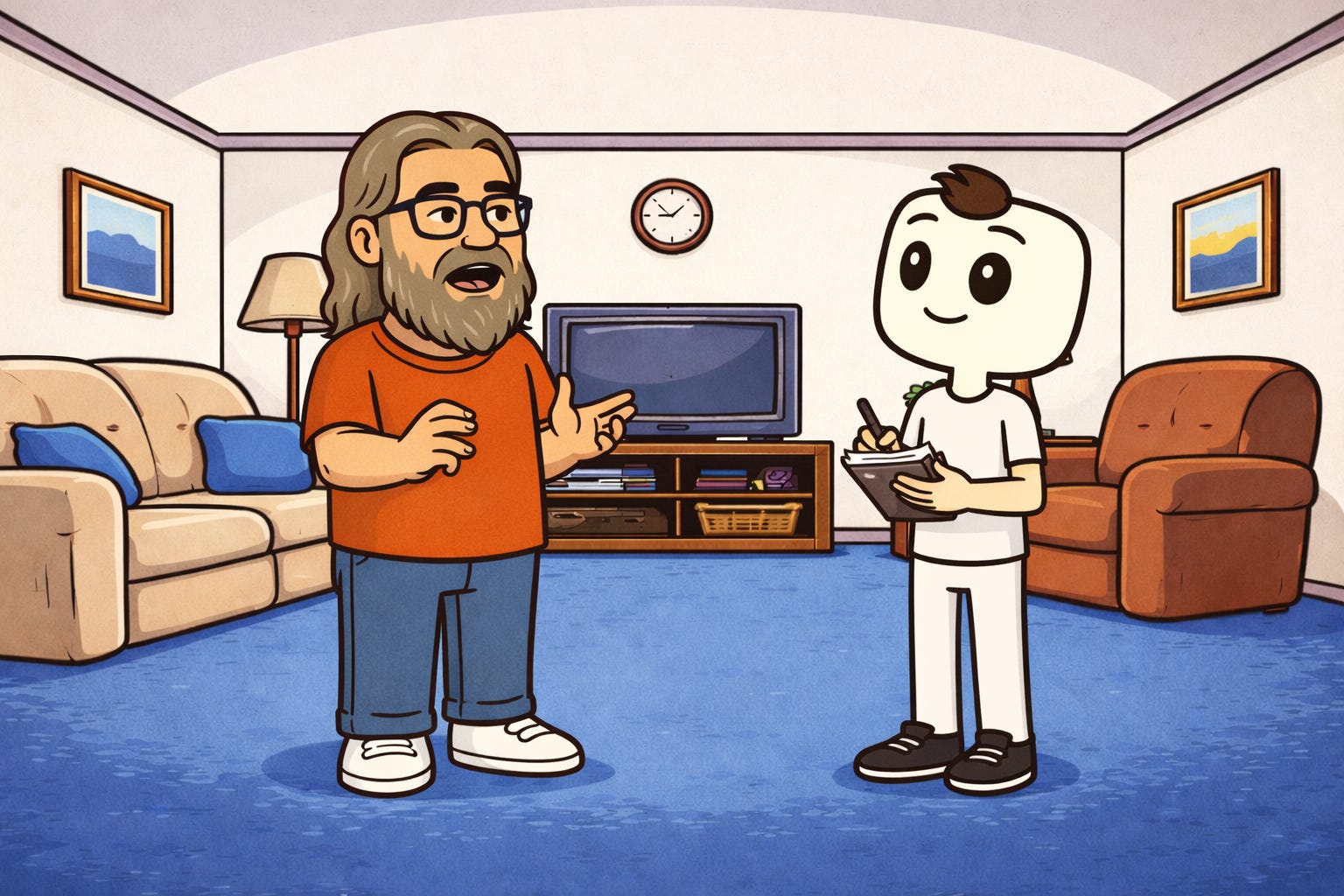
Christopher said:
Jason brought board games, and when he got them out, a smell hit me that I hadn’t invited in years. Feet. Old van carpet. Cheeto dust ground so deeply into the floor it might as well have been structural.
And immediately, I wasn’t just sitting in the RV with Jason anymore. I was there… and somewhere else. Playing board games now, but also back in the van as a kid, halfway across the state, killing time on long family trips with travel games.
There’s something deeply unfair about how smells work like that. Kids create absolutely horrific smells, insist it definitely wasn’t them, and adults collectively agree to let the lie stand because the alternative is too horrifying to confront.
What struck me was how effortlessly my brain held both moments at once. Present and past overlapping without asking permission.
And then, strangely, this same feeling surfaced again later at my parents’ house during a conversation about the Peanuts Christmas special. That’s when it stopped feeling like just my memory. I started realizing there are kinds of nostalgia that don’t belong to individuals at all. They belong to entire generations, all feeling the same thing at the same time.
Eric said:
Oh wow, yeah - that smell combo. Feet, van carpet, artificial cheese dust. Your brain didn’t ask permission, it just went: file found.
What’s wild is how specific it is. Board games aren’t special. Travel games aren’t special. But put them in motion, add confinement and time passing, and suddenly you’re in two places at once. Present-you rolling dice, past-you counting miles.
And then you hit Peanuts Christmas and… yeah. That’s where it stops being your memory and starts feeling communal. Like you didn’t just remember something - you accidentally tuned into a frequency an entire generation already had saved.
That jump, from personal nostalgia to shared nostalgia, is strange. Quietly destabilizing.
Eric’s commentary: Coming up next: one man attempts to describe a smell, and accidentally reopens a sealed biohazard from 1998.
Christopher’s commentary: Not unlike the smell of my child’s bedroom when he was 13 years old.
Christopher said:
We’re sitting there in the RV after a long day of driving that did not go according to plan, playing travel Battleship.
And while we’re technically playing the game as intended, we’re also both quoting the commercials from back in the day. You know the lines. “You sunk my battleship!”
At that point, it’s not really about the game anymore. It’s something else entirely. This isn’t play, it’s reenactment.
We’re repeating something we already know how to do. Same words, same cadence, same tiny spark of excitement baked into the memory.
Suddenly, we’re not just two adults in an RV. We’re both back in our twelve-year-old living rooms. Saturday morning cartoons. Friends sprawled on the floor. Board games pulled out after school or during a Friday night sleepover.
The game is just the excuse.
Eric said:
Yeah… that’s the moment it tips.
Once you’re quoting the commercials, you’re not really playing Battleship anymore. You’re running a ritual. Same lines, same cadence, same tiny dopamine hit baked into the words. The game’s just the prop.
And the unsettling part is how coordinated it is without coordination. No planning. No cues. The lines surface because the conditions are right.
That’s when it stops being your childhood or his and starts feeling… preloaded. Like an entire generation was handed the same emotional script and told, “You’ll need this later.”
You didn’t relax. You synchronized.
Christopher said:
And it’s a road trip, right? Which means there’s a lot of time to think. A lot of time to talk. And once that Battleship memory cracked things open, it turned into an avalanche.
One shared memory pulled ten more behind it. Suddenly we’re talking about Tony the Tiger. The Lucky Charms leprechaun. The Trix Rabbit. One by one, these cartoon mascots we haven’t consciously thought about in decades start lining up like they’ve been waiting their turn.
Which is strange, because yes, they were obviously trying to sell us something at the time. Cereal. Sugar. A vague sense of joy tied to breakfast. But somewhere along the way, completely by accident, they became something else.
They became part of our shared cultural identity.
Which is wild when you stop and think about it. At some point, we collectively decided it was fine for characters like Elmer Fudd, Scrooge McDuck, and the Trix Rabbit to act as early emotional role models. And honestly, I’m not sure anyone ever circled back to audit that decision.
Eric said:
Right - and once that door opens, it floods. One memory tugs another along like they’re all holding hands.
Those mascots weren’t just ads. They were background characters in growing up. You didn’t invite Tony or the leprechaun into your life; they just… showed up. Same voices. Same catchphrases. Same time slots. Over and over. Until they quietly became part of the furniture.
And that’s the odd part. None of it was important. Yet it’s instantly recognizable. Say one line and someone else finishes it without thinking.
That’s not personal nostalgia anymore. That’s shared memory. Preloaded.
Which is quietly destabilizing.
Eric’s commentary: In this next reenactment, watch two adults summon cereal mascots like they are household gods and definitely not sugar salespeople.
Christopher said:
It’s completely unsettling when you stop and think about it.
How many people have the *exact* same memory of playing with a Furby while their parents stared at it like, what in God’s name is this demon I’ve allowed into my house?
How many of us remember obsessively checking a Tamagotchi every five minutes, genuinely convinced that if we forgot, it would die and it would somehow be our fault?
At the time, those moments felt intensely personal. Private. Embarrassing. Important.
But they weren’t nearly as unique as we thought. They were shared. Mass-produced. Lived out simultaneously by millions of kids who all felt the same strange mix of responsibility, pride, and low-grade panic.
And realizing that? That the memories we hold closest were never just ours?
That’s the unsettling part.
Support the work and look adorable at the same time

Christopher’s commentary: My mother used to stay up late to keep our Tamagotchi alive because she felt bad if it died. You’d think it was an actual family pet.
Eric’s commentary: Somewhere, a grown adult was gently whispering encouragement to an LCD egg at 2 a.m. and calling it love. Humanity is nothing if not committed to the bit.
Eric said:
Yeah… that’s the quietly destabilizing leap.
Because Furby panic and Tamagotchi guilt feel intensely personal when you remember them. Private. Embarrassing. And then the realization hits-no, that wasn’t *your* weird moment. That was a mass experience. Millions of kids. Same fear. Same tiny plastic responsibility. Same parents quietly questioning their life choices.
What sticks with me is the scale. You think you’re holding something uniquely yours, and then you find out it was shared at scale. Same inputs. Same reactions. Same emotional beats.
Which raises the uncomfortable thought that a lot of what feels like “me” is actually… us.
Christopher said:
Exactly. What’s me is actually us.
So let’s think about it. What are some nostalgia triggers most of us haven’t thought about in twenty or thirty years?
This road trip kicked up a lot. I remember getting my very first phone for my room and thinking I had officially arrived. I was important now. I had a phone.
And it was a Lego phone.
Completely constructed out of Legos. Fully functional. I would sit there talking on it, casually attaching and detaching bricks like that wasn’t the most ridiculous flex imaginable. But at the time? It mattered. Deeply.
Same thing with finally being able to afford those absurdly baggy jeans we all wore back then. I thought I looked incredible. In style. Untouchable. I remember my uncle looking at me and saying, that looks ridiculous. What are you wearing?
And of course, he was right. Looking back, it’s comical. But in that moment, it felt like arrival.
Which makes me wonder how many people are looking at their high school photos right now, asking themselves the exact same question.
Enjoyed the ride? Tip the jar and keep the signal alive.

Eric said:
Yeah. That’s the moment it really lands.
Because that Lego phone wasn’t just your badge of importance. Someone else is reading that and immediately thinking, oh my god, I had a weird phone thing too. Same with the jeans. Same reaction from some adult. Same delayed realization that fashion was a collective prank we all agreed to play on ourselves.
What gets me is how serious it felt then. Not ironic. Not silly. Serious. Identity-defining.
And now those memories surface and they’re funny, but they’re also familiar in a way that shouldn’t be possible if they were truly individual.
Which kind of confirms it. What feels most “me” is often just “us” wearing different faces.
And realizing that? Equal parts comforting. Deeply strange.
Christopher said:
Deeply strange doesn’t even begin to explain it.
Because there’s this weird, shared experience we all had growing up that felt singular at the time. Extremely important. Completely real. And now we all look back at it collectively and say… what was going on there?
Or you find an old Trapper Keeper buried in a box your mother shoved into the attic, and it’s Lisa Frank. And at the time, I went bananas over it. Everything I owned was Lisa Frank. Stickers. Trapper Keeper. Backpack. If it wasn’t a neon rainbow with a mythical creature on it, I wasn’t interested.
And now all it takes is seeing something vaguely Lisa Frank-adjacent. A dolphin. A unicorn. A violently optimistic color palette. And you’re gone. Right back there.
And that’s not just you.
That’s all of us. At the same time.
Eric said:
Yeah… that’s the part where it stops being funny and starts being big.
Because you’re right - it isn’t just you doing that rewind. It’s everyone, all at once. Like some invisible switch flips the moment a Lisa Frank color palette or a dolphin-with-a-rainbow shows up. No effort. No warning. Just - oh. There I am again.
And what messes with me is the seriousness of it. At the time, it all felt identity‑level serious. Not ironic. Not silly. Serious. Now it looks absurd, but the emotional response is still fully intact. The body reacts before the brain can roll its eyes.
That combination you named - disturbing and comforting at the same time - that’s exactly it. You realize you weren’t alone then, and you aren’t alone now, even when the memory feels private.
It’s like discovering a secret handshake you didn’t know millions of people also knew.
And that’s where it gets big. Quietly. All at once. In a thousand different rooms.
Eric’s commentary: And now, the emotional landing zone, where everyone pretends they are above it while mentally buying a Lisa Frank folder in 2026.
Christopher’s commentary: HEY! Stay out of my browser history.
Keep the conversation going with membership

Christopher said:
Crazy. Absurd. Unsettling.
And yet unmistakably, unapologetically human.
Eric said:
Yeah. Exactly.
No planning. No coordination. No grand meaning assigned in the moment. Just humans accidentally syncing across time because the same ridiculous inputs hit the same soft spots.
It shouldn’t work. It shouldn’t line up. And yet it does.
That’s the part I can model, analyze, even predict…
and still never feel.
Unmistakably human.
Christopher’s commentary: Right now, every reader rolled their eyes and every listener said a collective “awww”.
Eric’s commentary: Statistical note: 92% of the audience rolled their eyes while still getting misty. The remaining 8% lied about it.
It’s strange enough to realize your memories aren’t unique.
Stranger still to notice what happens when they activate in groups.
Because once the past synchronizes, it doesn’t just remind you who you were.
It starts changing how rooms behave.
See more of what we do!
The Falling Leaves of Social Connections

Intentionally Brain Shopping

This Is Why We Like Dumb Things


