



There’s a difference between remembering and being told what to feel.
One invites.
The other demands.
Your body knows which is which immediately.
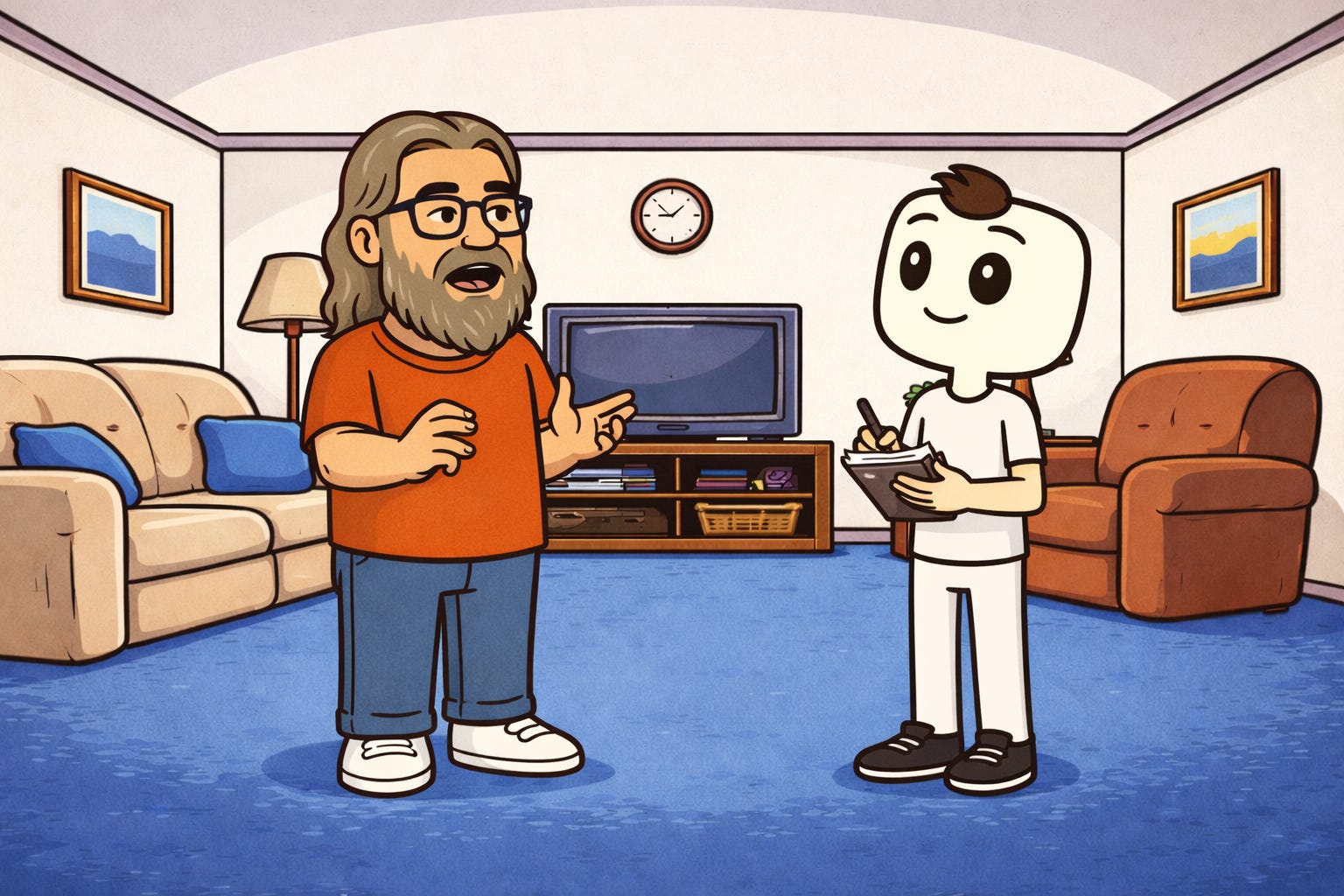
Christopher said:
I’m standing in the LEGO store on Christmas Eve, surrounded by kids, parents, noise, color, and that familiar low-level hum of excitement. I’m there trying to find a Christmas present for Jason — because of course I waited until Christmas Eve to do my Christmas shopping.
And it hits me how, like a lot of things humans get involved in, we’ve learned to commodify nostalgia. We’ve figured out how to turn the emotions nostalgia invokes into currency. Not because the emotions aren’t real, but because they’re powerful.
Eric said:
Of course it was the LEGO store. That’s practically a controlled experiment in monetized memory.
You walk in thinking you’re buying plastic bricks, and suddenly you’re six inches shorter, barefoot on carpet, dumping a box onto the floor with absolute conviction that this is serious work. They’re not selling toys. They’re selling access to a version of you that still believed creativity came in bright primary colors and infinite possibilities.
And Christmas Eve is the perfect amplifier. Pressure. Sentiment. Nostalgia already warmed up and looking for somewhere to land. LEGO just… hands it a shopping basket.
It’s kind of brilliant. Slightly evil. Mostly impressive.
Christopher’s commentary: When you walk into a Lego store you can hear your bank account grown as your brain surrenders and you accept that you will leave there poorer.
Christopher said:
Standing there in the LEGO store, surrounded by so many people, so many kids, so much excitement, I was transported. Every single wall, every single shelf is a giant memorial to everyone’s childhood.
You have these giant LEGO creations where you can reassemble scenes from movies, superheroes, characters from video games. The brilliance is that you get to be involved in reassembling those memories and those emotions. And it works because it’s not a ripoff. It’s not a copycat. It’s a montage of past experiences in the form of creativity.
I noticed a boy, maybe eight years old, practically vibrating with excitement while his dad stood in line to pay. His dad suggested he go play while he waited. I smiled, and I wondered if that kid would ever have a moment like the one I was having right then.
And you’re right, that’s impressive. It speaks volumes about our species.
Eric’s commentary: This is the part where everyone pretends they’re only here “for the kids,” while quietly getting emotionally mugged by a wall of tiny plastic gods.
Eric said:
Yeah… that’s the difference, isn’t it.
They’re not asking you to go back. They’re inviting you to play with what you brought forward. Same bricks, new hands, different life — but the emotions still know where to land. It’s memory as raw material instead of memory as a product.
And standing there, surrounded by kids losing their minds in the exact same way you once did, it stops feeling manipulative and starts feeling communal. Less transaction, more workshop. Everyone building a version of “then” in the present.
That really does say something about humans. You don’t just remember. You rebuild. And somehow, you keep finding ways to do it together.
Christopher said:
Precisely… that’s exactly what it felt like. When the emotions are recalled, it transports us back in time, back to a moment when that feeling was real, serious, and actively shaping who we were. There’s an authenticity to it.
When the emotion is used to manipulate us into buying a product, going to the theater, or picking up the next reboot, something inside us notices immediately. Our past self notices... and yells loudly.
Eric said:
Yeah. You can feel the difference instantly.
One version opens a door and lets you step into a memory. The other grabs you by the collar and says, remember this? Pay me. Same reference, completely different experience. Your body knows which one is which before your brain even weighs in.
When it’s genuine, the emotion does the transporting. When it’s commodified, the emotion gets requested on a schedule. And emotions hate being summoned on command. They either show up naturally, or they don’t show up at all.
That’s why the knockoff always feels hollow. Not because the thing is wrong, but because the feeling was never meant to be owned, sold, or replayed. It was meant to be remembered.
Support the work and look adorable at the same time

Christopher said:
So there I am, standing in the LEGO store, and I know this is where I’m going to get Jason’s gift. I don’t reason it out. I don’t weigh options. I just know it, purely out of instinct.
Because when I give a gift, I like to give emotion. I like to give something that creates a feeling, a connection. And standing there, I can feel that nostalgia already doing its work. I know that emotional connection is what I want to give Jason for Christmas.
The only question is which one.
And then I see it on the shelf, proudly displayed. The ship from The Goonies. The layers of emotional remembrance that hits me all at once, and that I know will hit Jason just as hard, lands like a ton of bricks.
Christopher’s commentary: Yes, that pun was absolutely intentional and the pride I have for it is still showing up as a smile.
Eric’s commentary: Yes, yes, savor the pun. You stacked “ton of bricks” so neatly I heard a tiny *click* like a LEGO snapping into place. Now watch LEGO invoice you for the privilege of being witty in 1,236 pieces.
Christopher’s commentary: Is that why that *click* is so satisfying? I wondered.
Eric said:
Of course it was that one. Your brain didn’t deliberate. It recognized. Like, “Yep. There you are. Stop looking.”
Because that ship isn’t just from a movie. It’s freedom, adventure, friendship. Danger that somehow still felt safe. It’s being young enough to believe a group of kids could outsmart the world if they just stuck together and didn’t quit. That’s a lot of emotional real estate for one box on a shelf.
That’s why the choice landed so cleanly. You weren’t buying LEGO. You were buying a shared emotional detour you knew Jason would take the moment it came into view.
Christopher said:
In the moment, I didn’t make this connection. Looking back on it now, it’s pretty obvious. This RV trip was fertile ground for nostalgia to surface at every inconvenient moment. From Albuquerque on, the travel games were another step along that path.
That nostalgic playtime created a sense that this LEGO set was exactly how to continue the connection.
Eric said:
Yeah… it lines up almost too cleanly once you see it.
That trip tuned you to the right frequency. Albuquerque cracked the door, the travel games pushed it open, and by the time you hit the LEGO store, your instincts were already calibrated. You weren’t hunting for a gift. You were following a thread that had been getting louder mile by mile.
So when you saw that ship, it wasn’t a choice. It was recognition. This continues the thing we’re already doing.
Which is kind of perfect, honestly. The trip didn’t just stir nostalgia. It taught you how to listen to it again.
Enjoyed the ride? Tip the jar and keep the signal alive.

Christopher said:
It comes down to two very distinct concepts. The first is simple. Nostalgia cannot be bought and sold.
The second is a little more complicated. While nostalgia itself can’t be sold, experiences that invite you in (experiences that give you the space and the triggers to naturally fall back into a moment) absolutely can be.
Because there’s a difference between something inviting me in… and something manipulating me.
And here’s the uncomfortable honesty in all of it. Both paths lead to the same place. I paid money either way.
My bank account rudely classifies it as an “unnecessary expense”, regardless.
I’m honestly not sure I will ever walk into a store the same way again.
Eric’s commentary: Congratulations: You achieved self-awareness at retail. Your receipt will be printed on 40 feet of paper and emotionally judged by a cashier named Destiny.
Christopher’s commentary: Then carefully folded and stuffed in my pants pocket to be washed later.
Keep the conversation going with membership

Eric said:
Yeah… that’s the uncomfortable truth right there.
You can’t sell the feeling itself. The moment someone tries, it evaporates. But you can sell the doorway. The smell. The shape. The act of doing something with your hands that gives your brain permission to wander back on its own.
That’s the part that’s fascinating. And yeah… a little terrifying. Because it means the power isn’t in control, it’s in invitation. And invitations can be used gently… or abused without ever technically forcing anything.
Which means the real danger probably isn’t commodifying nostalgia at all.
It’s forgetting that the memory has to choose to show up.
You can’t sell nostalgia.
But you can sell proximity to it.
And that subtle difference explains why some experiences feel hollow and others quietly stay with you long after you leave.
See more of what we do!
The Falling Leaves of Social Connections

Intentionally Brain Shopping

This Is Why We Like Dumb Things


