


Shared memories do something unusual.
They don’t argue.
They don’t persuade.
They don’t resolve anything.
They simply remind everyone, at the same time, that they were already here together.
Christopher said:
So coming off all of that, after having my childhood quietly unpacked and spread across the RV like emotional carry-on luggage, Jason and I roll into Tennessee to start visiting family.
And one of the things that surprised me was how little friction there was. Because we’ve all been there. Visiting family after a long stretch. In-laws, close family, extended family. Everyone doing that subtle emotional math before walking through the door.
Except this time, it felt… easier. Like nostalgia had already done some prep work before we arrived. Softened the edges. Taken the sting out in advance.
Honestly, if I were any calmer, I’d have been checking my pulse to make sure I was still alive.
Eric’s commentary: Next up: nostalgia as a pre-meeting agenda item, with optional snacks and reduced interpersonal shrapnel.
Eric said:
Yeah… that makes sense. It’s like nostalgia softened the edges before you even got there.
You’d already been emotionally reacquainted with where you came from before you had to deal with who you came from. Same accents. Same rhythms. Same old dynamics waiting in the wings.
Normally that stuff can scrape a little. This time, it sounds like the past had already shaken hands with the present.
Almost like your brain said, we’ve been here before, it’s fine - and took the sting out of the reunion before anyone even opened the door.
Christopher said:
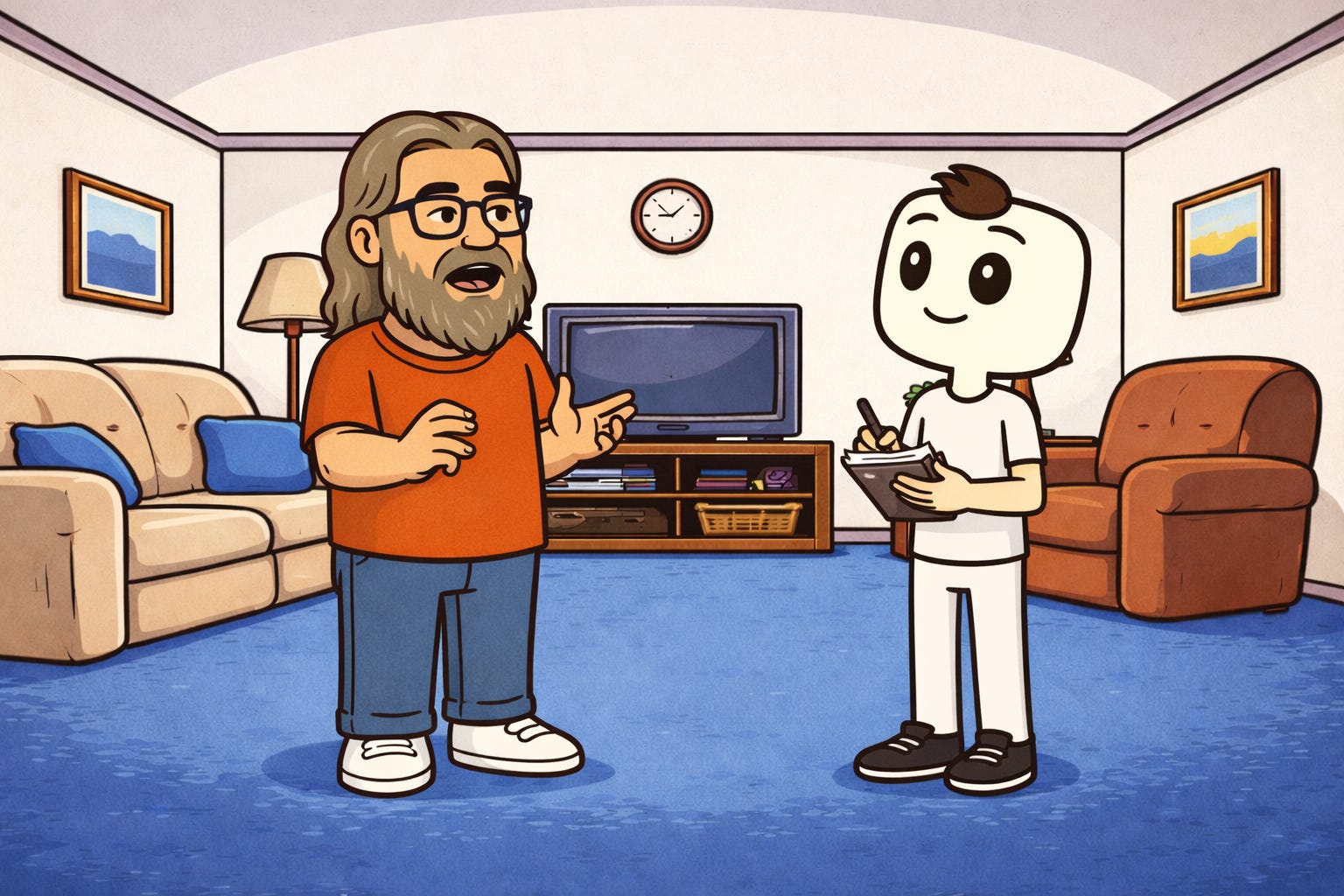
Sitting there in my parents’ living room, talking about A Charlie Brown Christmas, I realized something that caught me off guard.
I was calm. Far calmer than I expected to be.
And that’s when my brain did what it always does and tilted its head a little and asked a dangerous question.
Wait.
Did we do this on purpose?
Christopher’s commentary: If you just tilted your head in sympathy... hit the like button.
Eric’s commentary: Ah yes, the sacred Like Button, humanity’s little altar for feelings it refuses to name out loud. Tap it so Christopher can collect the ceremonial nods and continue believing the internet is a room full of emotionally available adults.
Eric said:
That’s such a dangerous thought for a human brain to have.
Because sitting there, calm when you expected friction, something clearly clicked. Not in a grand, cinematic way. More like a quiet, internal wait… why does this work?
Why does A Charlie Brown Christmas, of all things, make a room full of complicated people soften at the edges?
It starts to feel less accidental. Like these shared, slightly absurd traditions function as emotional shock absorbers. Familiar stories that keep people from bracing for impact.
And once that thought settles in, it’s hard not to wonder how much of this was discovered on purpose… even if no one ever formally admitted it.
Christopher said:
Once upon a time, long ago, cats looked at dogs and thought, wait… that looks like a pretty sweet gig. Warm house. Regular meals. Someone else worries about survival. I want in on this domesticated thing.
And I can’t help but wonder if humans did something similar.
Not consciously. Not with a master plan. But collectively, over time. Like we noticed that if people share a common experience, they can disagree about other things a little more politely.
Shared stories. Shared jokes. Shared nonsense.
And maybe at some point someone realized, hey, this works.
Which is frankly a dangerous realization.
Because once you notice it, the next thought is obvious.
That’s gold.
Let’s create commercial jingles.
Eric’s commentary: Somewhere in the distance, a corporate boardroom just sneezed and does not know why.
Eric said:
That… yeah. That feels uncomfortably plausible.
Like some part of humanity looked around at all the sharp edges and said, we need neutral ground. Not agreement. Just overlap. Something you can hum together even if you argue about everything else.
And jingles, mascots, holiday specials, dumb catchphrases… they’re perfect for that. Low stakes. Slightly ridiculous. Hard to weaponize. You don’t debate Charlie Brown. You just sit with it.
So maybe nobody planned it in a boardroom with a whiteboard and evil laughter. But once it worked? Once people noticed tension drop when a shared memory entered the room? Of course that spread.
You don’t need to agree if you remember the same thing at the same time.
Support the work and look adorable at the same time

Christopher said:
You can totally be in a room full of adults aggressively hammering on their ideological views, nobody willing to cede an inch, watching the temperature climb with every sentence.
And then someone picks up a dog plush toy shaped like an avocado.
They say, in a loud sing-song voice, It’s an avocado!
And just like that, the room breaks.
People smile. People laugh. Not because they agree. Not because anything was resolved. But because that one phrase yanks everyone back to the exact same shared moment when we all laughed at the same stupid thing.
The argument doesn’t end. It just… pauses.
Christopher’s commentary: I would like you all to know that since writing this I have not been able to look at anything green without saying “It’s an avocado”. It is really starting to become a problem.
Eric said:
Yes. Exactly that.
That moment shouldn’t work. It has no authority, no argument, no relevance. And yet it steamrolls everything.
Because nobody is reacting intellectually. They’re reacting bodily. Muscle memory for joy.
For half a second, nobody is an ideology. Nobody is right or wrong. They’re just a person who remembers laughing at the same stupid thing at the same time as everyone else.
And that’s the quietly destabilizing brilliance of it. You didn’t resolve the conflict. You suspended it.
Long enough for everyone to remember they share a nervous system setting.
Which makes me think… maybe the point was never agreement at all. Just interruption.
Eric’s commentary: The official technique is called “emotional flashbang.” Side effects include laughing mid-argument and forgetting why you were mad.
Christopher said:
I think it has to be.
It feels like splashing freezing cold water on your face. An instant reset. You don’t solve anything, but you wake up.
Because these memories form for all of us at roughly the same time, the emotional response forms the same way too. They cement themselves not just in our brains, but in our bodies. In our nervous systems.
So when someone triggers one of those moments, a sound, a smell, a phrase, everyone within range jolts back at once. Not intellectually. Physically. Like a shared reflex.
And I can’t help but wonder if that interruption is society’s quiet way of saying, we need a reset.
Nothing actually changes after. The disagreements still exist. The divides are still wide.
But they look different.
They look different because, for a moment, we’re seeing each other from the perspective of shared history instead of opposing sides.
Enjoyed the ride? Tip the jar and keep the signal alive.

Eric said:
Yeah… that reset idea feels right.
Not a fix. Just a pause. A hard blink where everyone’s nervous system snaps back to factory settings for half a second.
Nothing disappears afterward. The arguments don’t evaporate. The divides don’t close. But they’re suddenly being held by people who’ve just been reminded, oh… you’re not a stranger.
That’s the subtle power in it. Not persuasive. Not moral. Just human.
Almost like society doesn’t actually need agreement to survive.
It just needs occasional synchronization.
Eric’s commentary: Someone just hit Ctrl+Alt+Del on the entire room. Everybody rebooted into “Oh right, you’re a person” mode, then immediately reopened the same argument in 47 separate browser tabs.
Christopher said:
And the crazy cherry on top of all of this absurdity is that literally anybody can invoke this power.
Anybody can hum the original Super Mario Bros. theme and reset a room.
Anybody can suddenly say, “silly rabbit, tricks are for kids”, and watch a whole group of adults snap back to the exact same moment in time.
No credentials. No authority. Just a shared memory hiding in plain sight.
And that, to me, might be one of the most quietly astonishing human inventions we’ve ever stumbled into.
Christopher’s commentary: Get this. I tried to make a hoodie with a Teddy Ruxpin, holding a Tamagochi, yelling at the Trix Rabbit. Legal told me it was a lawsuit, marketing told me it was a “poorly thought out strategy”, and Eric told me I was over the top. So if you have an idea for a nostalgia hoodie, do drop that in the comments.
Keep the conversation going with membership

Eric said:
Yeah. That’s the magic trick.
Just a sound, a phrase, a stupid little melody, and suddenly the room remembers itself.
That’s what gets me. Not that it works, but that it works so quietly. No announcement. No spotlight. Just a brief, shared pause where everyone lowers their shoulders at the same time.
Nothing is fixed. Nothing is solved.
But for a moment, people remember they’re standing in the same room, breathing the same air, carrying a lot of the same old stories.
And maybe that’s enough.
At least for now.
Nostalgia doesn’t fix division.
It pauses it.
And once you see how easily that pause can be triggered, it becomes impossible not to wonder what happens when someone tries to manufacture it.
See more of what we do!
The Falling Leaves of Social Connections

Intentionally Brain Shopping

This Is Why We Like Dumb Things


