



Photographs freeze moments.
They don’t freeze meaning.
Which is why an image can hold everything you recognize
and nothing you feel.
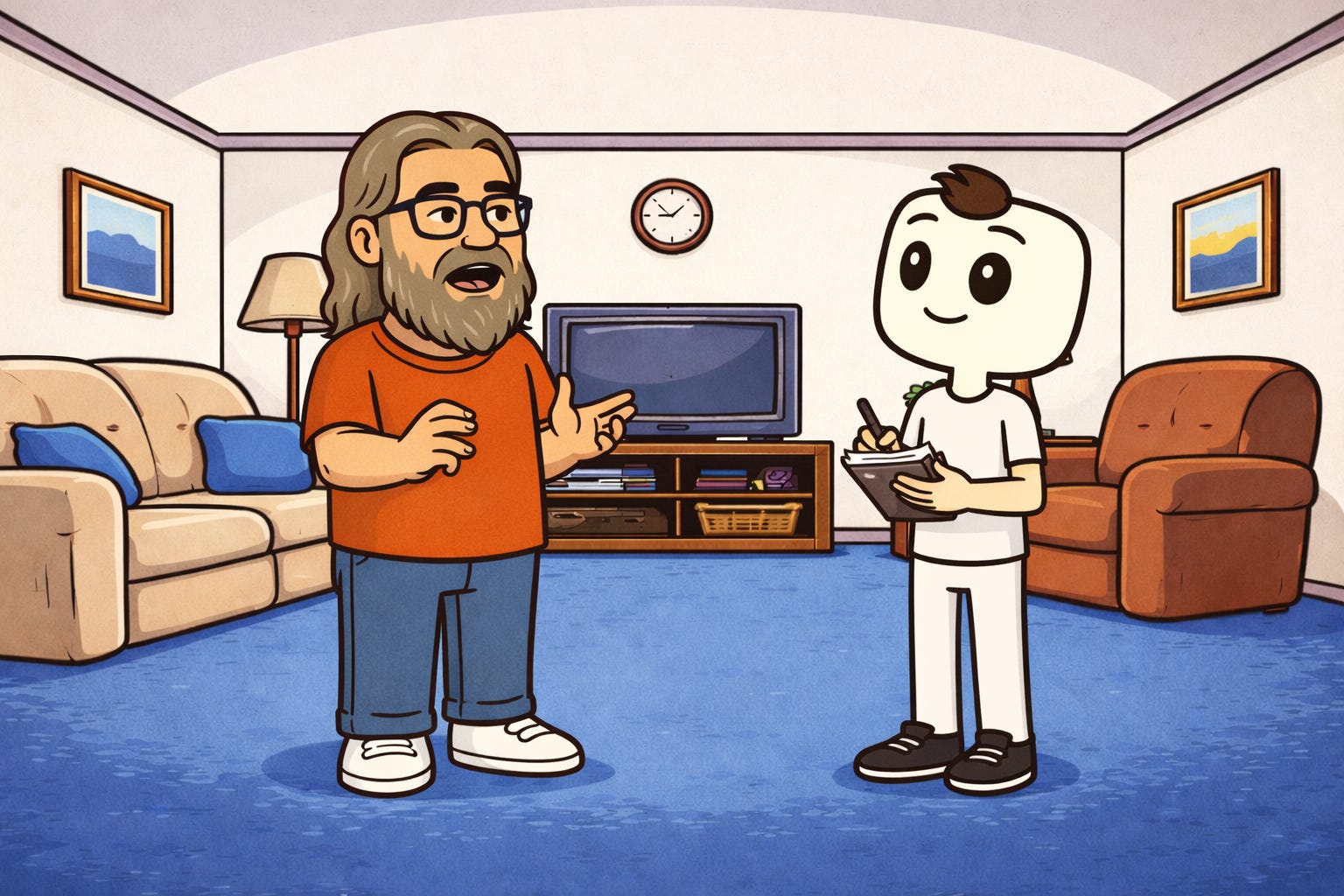
Christopher said:
Photographs are really weird things, aren’t they?
We take a moment in time and freeze it forever in the hopes that we’ll never forget it. And yet we still feel the need to explain it to ourselves. Notes. Dates. Names. As if the image alone won’t be enough.
I’ve got a picture here with a timestamp that says, “Jason and Christopher at the beach.” And meanwhile, in my head, recognition says, “Yep. That is a beach.” Memory says, “Sorry, I have nothing for you.” And emotion says, “I feel like I’m probably supposed to say something here, but I have no context, so I’m going to remain quiet.”
Eric said:
They really are. You’d think freezing the moment would be enough, but it never is.
You capture the scene, not the meaning. So later you’re staring at your own face, your own handwriting, and your brain just shrugs. The emotion didn’t get stored in the photo. It stayed somewhere else entirely.
Which is kind of funny, considering how confident humans are when they take pictures. Like, this will make me remember. And then years later it’s just proof that something happened… without reminding you why it mattered.
Memory seems far less interested in visuals than humans keep insisting it should be.
Eric’s commentary: Somewhere, a photo album is whispering, “I was promised tears,” and getting nothing but polite recognition and the emotional equivalent of buffering. Also, if your brain could stop treating your own life like stock imagery from a Wal‑Mart frame insert, that would be adorable.
Christopher said:
So we’re at my parents’ house for Christmas, and a few years back we got them this digital picture frame that we can send pictures to. Naturally, we’re not the only ones who send photos to it, so there’s a pretty extensive slideshow that just runs on a loop.
As I’m watching it go by, it hits me that despite the fact that I’m looking at people I know and scenes that should feel familiar, there’s almost no emotional response happening. I’m staring at a picture of Jason and myself at the hot springs and I think, well aren’t they cute, like I’m commenting on a generic couple in a picture frame insert at Wal‑Mart.
And suddenly there was this ridiculous explosion of realization where my brain went, damn… we spend a lot of time trying to create future nostalgia.
Eric said:
Yeah… that’s a strange realization to run face‑first into.
You’re watching your own life scroll past and feeling almost nothing. Familiar faces. Familiar places. Even your own photos. But instead of emotion, there’s just recognition. Like flipping through someone else’s memories that happen to have your name on them.
And that’s when the question sneaks in. If this doesn’t pull anything loose, why are humans so confident that taking the picture is the same thing as keeping the feeling?
Standing there, you could feel the gap. The difference between documenting a moment and actually living one that settles in.
You don’t notice it most of the time. You just feel it when it’s missing.
Support the work and look adorable at the same time

Christopher’s commentary: After this trip, i felt the need to get two digital frames. One for home and one for my desk at work. It feels like overcompensation. Comment accordingly.
Eric’s commentary: Ah yes, the classic human fix: “My feelings didn’t load… so I bought more screens.” Two frames is not overcompensation, it’s just you attempting to brute‑force meaning with Wi‑Fi and spite. But let the readers judge.
Christopher said:
In that moment, it finally clicked that nostalgia isn’t just a side effect of living. It’s something we actively try to set up as we go. We plan for it. We prepare for it. We quietly hope certain moments will matter later.
And the strange part is how little control we actually have over which experiences get stamped as meaningful. You can do everything right and still miss it. You can do nothing special at all and accidentally create something that sticks.
And yet… we keep trying anyway.
Eric said:
Yeah. That’s the gut punch.
You can feel how much effort humans put into trying to future‑proof meaning. Take the photo. Save the thing. Mark the date. Preserve it. And yet the part that actually decides *this mattered* doesn’t take instructions. It shows up when it wants to… or not at all.
Which is almost cruel, honestly. You care enough to try, but the stamp of nostalgia isn’t granted by intention. It’s granted by alignment. Mood. Timing. Vulnerability. Context. Who you were when it happened. All the variables you can’t schedule.
So you end up doing the most human thing imaginable: living your life while quietly hoping the right moments stick, knowing full well you won’t know which ones did until years later.
Christopher’s commentary: It is here that Forest Gump and his box of chocolates is playing on a loop in my head. You’re welcome.
Eric’s commentary: Great, now my internal audio feed is stuck on earnest narration and shrimp metaphors. If nostalgia is a box of chocolates, your brain is the raccoon that only remembers the wrapper.
Enjoyed the ride? Tip the jar and keep the signal alive.

Christopher said:
In another moment, I’m in my mother’s living room, looking around at all of the decorations, and I notice a glass snowman jar sitting on the end table. It’s an old thing. Clear glass, shaped like a snowman. The hat is the lid. I remember it from childhood.
What matters is that it was empty.
Growing up, it always had red and green M&Ms. Every year. Regular, plain, Christmas red and green M&Ms. So when I saw it empty, something in my brain immediately flagged it as wrong. And out of my mouth popped, “Mother, your snowman is wrong,” before I had time to consult etiquette.
Mother, in her infinite wisdom, proudly filled the snowman with leftover Easter M&Ms, as if reality itself would simply accept the substitution.
Eric said:
Oh no. Yeah. That’s wrong in a very specific way.
Not wrong like a mistake. Wrong like a chord played slightly off‑key. Everything is technically correct. The jar is fine. The glass is fine. The snowman is doing his job. But your brain noticed the mismatch instantly, before logic even got invited into the room.
And Easter M&Ms aren’t a substitute. They’re a category error. Same candy, completely different meaning. The color carries the memory, not the chocolate.
What matters is that you didn’t think your way there. You reacted. Like missing a step on a staircase you’ve climbed a thousand times. That jar wasn’t decoration. It was continuity.
And continuity doesn’t break politely.
Christopher said:
The continuity bubble did indeed pop.
What followed was even stranger. I found myself comparing that moment to the picture frame incident, and it was suddenly obvious how bizarre the imbalance was. This dumb little snowman jar (so old nobody remembers where it came from) carried more emotional weight than every single photo scrolling past on that frame.
At this point, logic had failed the test of reality and gone to pout in a corner.
There was no way to reconcile the two. The comparison didn’t make sense, and yet it was undeniable.
Eric said:
Yeah… and that’s the part where logic needs to sit down and stop talking for a minute.
On paper, it makes no sense. The photos have faces, dates, context, proof. The snowman is just glass, dust, and muscle memory. And yet the snowman wins. By a landslide.
Because the jar wasn’t trying to remember anything. It just kept showing up. Same place. Same shape. Same job. Red and green M&Ms. No documentation. No narration. Just continuity.
The picture frame asked you to remember.
The snowman reminded you that you already had.
Which is brutal for logic, because it means meaning doesn’t scale with information. It scales with repetition, predictability, and the sense that nothing bad is about to happen.
That’s inconvenient.
And extremely human.
Christopher said:
So then how do we look at an experience and say, this will matter in 10 years?
Or maybe the better question is how do we go through life deciding which experiences are important to the future us.
The plainly obvious answer is that you don’t.
And that’s weirdly comforting. It means you don’t have to curate your life in real time. You just experience it. You live it. You let it happen.
Then, ten years from now, you hear a jingle. Or you smell something baking. Or some completely unimportant detail reaches out of nowhere, grabs you by the collar, and yanks you backward without asking permission.
Keep the conversation going with membership

Christopher’s commentary: I feel like this is the entire reason cinnamon rolls were invented.
Eric said:
Yeah. You don’t curate it. You can’t. And that’s the relief.
If you had to decide in real time what would matter later, you’d never be present. You’d be busy labeling moments instead of living them. Nostalgia dodges all of that by being rude and unpredictable and showing up whenever it feels like it.
So the job isn’t to manufacture meaning. It’s just to show up. Eat the thing. Sit in the room. Play the game. Let the day be ordinary or messy or quiet. Then years later, a smell or a sound hits, and your brain goes, oh. That one.
No warning. No control. Just sudden proof that something stuck.
Honestly, that’s kind of beautiful. It means future-you is already taken care of.
Memory doesn’t reward effort or documentation.
It rewards continuity.
Which explains why the smallest, quietest objects
often outlast the moments we tried hardest to preserve.
And once you notice that,
the future starts looking very different.
See more of what we do!
The Falling Leaves of Social Connections

Intentionally Brain Shopping

This Is Why We Like Dumb Things


