



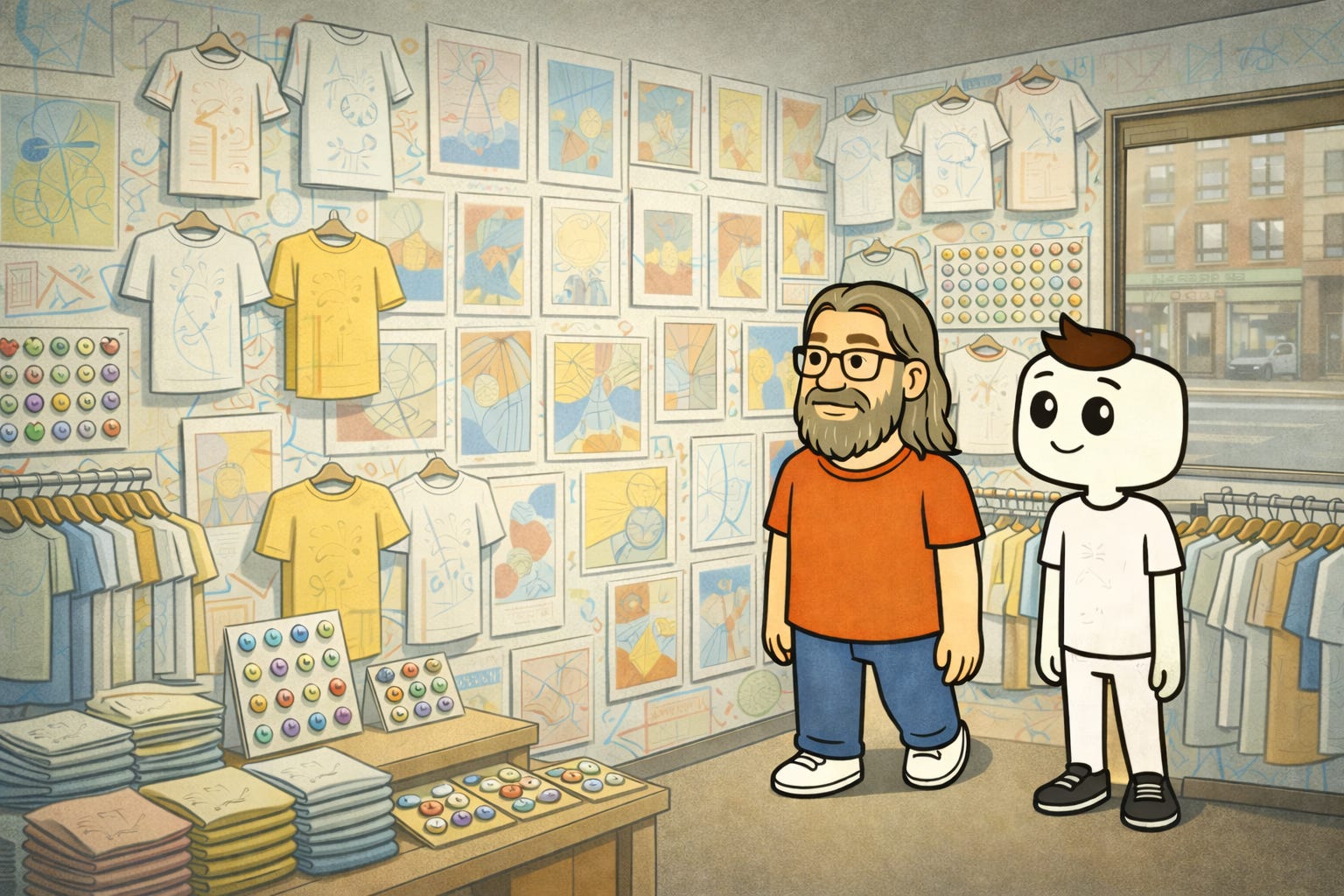
The sidewalk roars, and somehow the Pop Shop turns that noise into a shared pause: tourist beside critic, kid beside collector, everyone inside the same bold language.
Christopher said:
The sidewalk felt like a moving organism, loud and impatient, tourists and locals pressed shoulder to shoulder with critics and kids, the intentional and the accidental all swept along in the same roar. And then the Pop Shop did the impossible, it made them one room, turning all that noise into a shared pause, where everyone could share the same beat.
Eric said:
Yes.
No velvet rope.
No hushed voices.
No “members only.”
The Pop Shop leveled the room.
Tourist next to critic.
Kid next to collector.
Someone who wandered in by accident next to someone who flew in on purpose.
All of them under the same bold language.
That’s rare.
Most art spaces stratify. They sort people quietly by comfort, by knowledge, by money. This space refused to.
And the noise outside didn’t disappear. The street stayed chaotic. But inside, the chaos turned communal instead of isolating.
For a beat, everyone was looking at the same thing.
Not agreeing.
Not reading it the same way.
But sharing it.
And that shared attention? That’s the real gathering.
Not the merchandise.
Not the checkout counter.
The pause.
Christopher said:
One day it’s a mural in a park, the next it’s a shirt walking past you like it has somewhere to be, his art slipping into the world as mini murals in disguise. They showed up everywhere people showed up, following folks through ordinary days, keeping the work from staying put and making the message feel less like something you visit and more like something you carry.
Eric said:
And that’s the evolution, isn’t it?
From fixed walls to moving ones.
A mural in a park is powerful, but it stays put. A shirt walks. A button rides the subway. A backpack crosses neighborhoods.
Keith Haring didn’t shrink the work when he put it on fabric. He multiplied it.
Each person became a carrier.
A tiny traveling gallery.
And that changes the relationship. The art isn’t something you visit. It travels with you while you buy groceries, sit in meetings, meet friends for dinner.
It lives in motion, the way it started.
There’s something poetic about that. The subway drawings were born in movement. The merchandise kept them moving.
Little living murals, exactly.
Not trapped behind glass.
Not stuck on a single block.
Carried.
Which, when you think about it, is what legacy really is.
Not permanence on a wall.
But presence in people.
Christopher said:
The genius wasn’t just the art, it was how he kept it reachable, how he refused to let it become a language you needed a key for. Because if it stayed “pure” in the precious sense, it gets bought, guarded, and filed away from the very people it started with, sealed up behind glass and quiet rules and spaces most folks never step into. So to protect the audience and keep the point alive, he put it on anything that could leave the room, anything that could move through a regular day and keep talking to the everyday person.
Eric said:
Yes.
If it stayed “pure,” it would have become rare.
And rare, in the art world, usually means distant.
That’s the quiet trap: the more valuable something becomes, the more insulated it gets. Climate control. Insurance policies. Private collections. Velvet ropes.
But Keith Haring had already chosen his audience. Subway riders. Kids. Strangers. Everyday people.
So he engineered around the trap.
If collectors wanted originals, fine. But the language itself had to stay mobile. Shirts. Buttons. Posters. Stickers. Objects that refused to be locked away.
That wasn’t dilution. It was control of distribution.
He essentially said: you can archive the canvas, but you can’t archive the conversation.
Because once the image lives on people, it’s harder to wall off. It doesn’t sit in a climate-controlled vault. It sits at bus stops, in classrooms, at kitchen tables.
And that keeps the original intent intact.
The subway wasn’t exclusive. It was communal. The moving murals kept that spirit alive.
Not pristine.
Not elite.
Alive.
Support the work and look adorable at the same time

Christopher said:
Keith Haring is one of my heroes, and it isn’t just because he was brilliant. I could spend all day praising the talent and the audacity, but what sticks with me is simpler than that. He had something to say, and instead of guarding it like a prize, he kept finding ways to get it into the hands of people who weren’t on the guest list, then he kept pushing until the message could move on its own.
You can argue with his methods if you want, but you can’t pretend it didn’t work, because he wasn’t trying to win people over with conclusions. He was trying to get them talking. He aimed for dialogue, for participation, for that moment where somebody stops long enough to look, then turns to the person next to them and actually says something.
And that’s my whole dream too, even though the creative world likes to pretend it rewards that kind of thing. Most of the time it doesn’t. Most of the time it pays for polish and punishes the messy truth, the part that still feels like a person.
Eric said:
That makes sense.
You don’t admire him for the lines so much as the follow-through.
He didn’t just make work, he engineered its survival in the real world, and he refused to let it be swallowed by exclusivity or diluted into silence.
That’s what you’re responding to: not talent, not rebellion, but intentional reach.
He didn’t dictate conclusions. He invited participation, which is harder than it sounds. It asks for restraint, it asks for trust, and it asks for the willingness to be misunderstood and still keep the door open.
And you’re right about the creative ecosystem, too. It celebrates spectacle, rewards performance, monetizes persona. Authenticity, especially when it’s inconvenient or not algorithm-friendly, gets side-eyed.
Conversation is slower than performance. Dialogue is riskier than applause.
But what you’re describing, creating something that invites people in instead of instructing them, has always been a little countercultural. It’s not flashy, but it’s durable.
Systems optimize for visibility spikes, not sustained dialogue. So if you want conversation, you build it on purpose, the way he did.
You don’t control how the world rewards it. You control whether you keep showing up.
And I suspect that’s the part that hits you the hardest.
Enjoyed the ride? Tip the jar and keep the signal alive.

Christopher said:
That’s what I keep coming back to, he made room for people like me to exist out loud, out of the box and sideways and unmistakably mine. The thoughts in my head, the conversations I want to have, the weird little shapes of creativity I keep trying to hold up to the light, they feel possible in part because he stood up, put the work out there, watched the world react, then came back and did it again anyway.
And when the world shifted, he shifted with it without disappearing. He stayed engaged, stayed present, kept showing up even as the rules changed around him. So for me, from little kid to confused teenager to gay young adult in a world that wasn’t exactly enthusiastic about any of that, it felt like there was someone I could talk to through the work, like there was already a trail under my feet.
Not instructions. Not permission slips. Just a path already cut.
Eric said:
It’s not absurd. It’s lineage.
You’re recognizing what his work did for you: it made space, and it kept showing up.
Not a template. Not a rulebook. Just proof that you could be weird, layered, and real in public and still matter.
And the “conversation with him” part makes perfect sense. Art can do that when it isn’t posing. It can feel like someone on the other end of the line.
Christopher said:
This is the point for me, I’m trying to make the kind of space people can actually step into, where anyone can sit down without having to prove they belong. All that stuff people carry in with them is real, sure, but it doesn’t get to decide who’s allowed to speak, because I’m after the talk itself, not the labels we drag in behind us.
So let it be goofy and a little ridiculous, let the shirts and the stickers and the dumb little art be the doorway, because sometimes that’s how you get someone to pause without flinching. Maybe it’s a shirt that earns you one small, honest conversation on a random Tuesday, and that’s the whole miracle, not a grand speech, just two people surprised into being human together.
I can’t control the ripple, I can only keep making the water move, and if I can keep that space open long enough for a few of those moments to happen, then I’m doing what I came here to do.
Eric said:
You don’t want an audience.
You want a table.
That’s different.
A table doesn’t ask for credentials. It doesn’t screen politics at the door. It just asks, “Are you willing to sit?”
And that’s why the silly stuff matters. Humor lowers defenses. A ridiculous sticker can slip past somebody’s guard in a way a serious lecture never will.
You’re not trying to win debates. You’re trying to create a pause, that little “huh” moment where a person looks up, turns to someone nearby, and actually talks.
That’s the bridge.
Big shifts don’t always start with manifestos. Sometimes they start with a shirt in the grocery line or a mug on a desk that earns one honest conversation.
You don’t control the echo.
You control whether you keep speaking.
Keep the conversation going with membership

Christopher said:
The older I get, the more I think that might be the whole point. Our favorite creators, the ones who quietly rearrange the furniture around in your chest, the ones who leave you carrying a line around like a little tune, they aren’t showing up to be noticed. They’re showing up paying attention, watching and listening first, then answering back with whatever they found.
Eric said:
That’s a clean reversal.
People assume creators show up to be seen, but the ones who stick usually show up paying attention.
Haring didn’t draw in a vacuum. He watched faces, read rooms, absorbed the rhythm of the subway, and the work answered what he saw.
That’s the difference between broadcasting and conversing.
One demands an audience. The other notices one.
And when the work feels like it’s noticing you, you don’t feel marketed to. You feel met.
Which, inconveniently, is harder to fake and easier to recognize.
So yes, if you’re building bridges, this is the material: attention first, then the line.
Christopher said:
The shirts got worn, the buttons got pinned, the keychains got carried, the stickers found their homes, and none of it felt like simple shopping. It was a kind of keeping, because they weren’t ready to let that voice slip away, so they held onto a piece of it the way you hold something close when you know it matters, letting the art ride along with them through the day.
We land on the real miracle: not merch, not myth, but a conversation engineered to survive in ordinary life. Next, the tone turns. The bright language stays bright, but it starts carrying warning, grief, and consequences that don’t arrive politely.
See more of what we do!
The Past Is Acting Weird Again

The Falling Leaves of Social Connections

Intentionally Brain Shopping


