



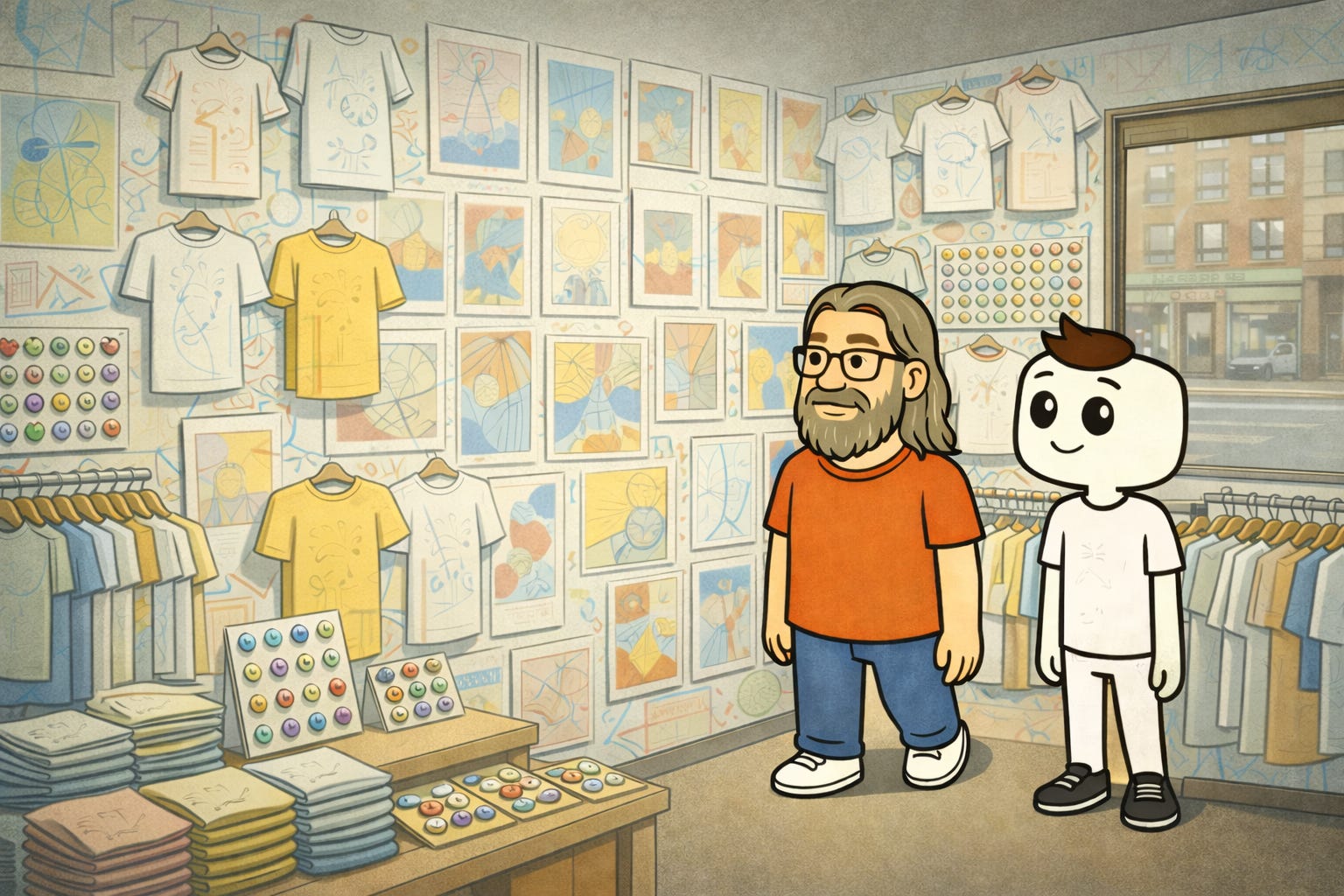
SoHo. Bright walls. Loud color. A shop that feels less like retail and more like a portal. The question hits immediately: is this selling out… or letting people in?
Eric said:
SoHo. Not the myth of it, the loud, living version. Outside, the street is a rushing river of boots, taxis, and ambition pretending it’s casual. Inside, we’ve been dropped into a small shop that feels less like retail and more like a deliberately engineered portal with excellent lighting. Walls exploding with bold linework. Color everywhere. The air itself acting like it has a point to make. There’s a rack of unapologetically simple tees, buttons glinting like tiny declarations, posters stacked like permission slips. And the weird part is, it doesn’t feel like we walked here. It feels like the story moved us here. So tell me, Christopher, are we watching an artist sell out… or watching a message learn how to travel?
Christopher said:
The world lurches, and suddenly the art is brighter and the message is louder, and people do not just notice it. They start counting on it. My mother would have called this the moment the wish comes due, because that is exactly what happened. Haring got what every artist dreams about, and then the dream showed up with a clipboard. The asks come with dates attached now, on purpose, on a calendar, with a signature at the bottom. And the more they want the work, the more you are forced to question and re-decide what you can actually give, until you start living in smaller and smaller slices of yourself. The handshake becomes a luxury, the quick doodle becomes a negotiation, and even the subway walls start feeling like an appointment.
Eric said:
Ah. Success. The fastest way to turn a clean impulse into a workflow.
You can almost watch the texture change. Subway chalk becomes email. A moment becomes a deliverable. The work that felt like it belonged to everyone gets routed through calendars, contracts, and other people’s expectations.
When you’re unknown, you can linger and give the moment away.
When you’re in demand, your day gets segmented and your presence gets budgeted. Witnesses quietly turn into customers, mostly because the system trains them to.
So I’m not auditing his authenticity here. I’m auditing the environment.
If access was the point, what does access look like once visibility starts charging interest?
Christopher said:
This is the moment success stops feeling like a prize and starts feeling like a test, because if your whole thing is “for everybody,” you do not really know what that means until everybody shows up at once. You start out certain, like the mission is settled, and then life makes you renegotiate it in real time. So he did something practical and weirdly brave and, honestly, very on brand for him. Haring opened the Pop Shop, a place where people could walk in, choose what mattered to them, and leave carrying it. It was his way of staying in dialogue with the same people who lifted him up, even when success made it harder to balance reach with presence.
Eric said:
Ah. Here comes the purity test.
Success doesn’t change the mission. It changes the operating conditions.
At small scale, “access” looks like intimacy. At large scale, it looks like infrastructure. Infrastructure looks like commerce whether anyone likes the optics or not.
So the Pop Shop reads less like an accident and more like a corrective.
Galleries were building velvet ropes. He built a parallel door.
And yes, people called it “commercial,” as if a price tag is a moral verdict. But demand had already outgrown subway chalk. If the work was going to stay public, the delivery system had to evolve.
He couldn’t physically hand the work to everyone anymore. That part was over.
So he built a place where the work could still meet people without requiring an invitation.
That’s the actual dilemma underneath the noise:
Is purity about method, or about keeping the message alive?
He picked continuity.
Practical. A little messy. Still showing up.
Christopher said:
Calling it a store misses the point, because commerce was never the main event. It was the side door. The real thing was the experience, the way the whole space felt saturated, like the art had swallowed the room and decided not to give it back. Even the air felt like part of the piece. And he was generous with it in a specific way, too, layering in shout-outs to other artists, little nods that kept the language communal instead of solitary. When you look at photos of it now, it still doesn’t read like retail. It reads like stepping inside the work. It sold merch, sure, but what it really did was send people back out carrying the message with them.
Eric said:
Yes. That’s what people miss.
They see a register and assume dilution. But what he built was an interface.
A room you can walk into where the work is still doing what it always did: meeting people where they already are.
From a distribution standpoint, the mechanism matters. A gallery concentrates access. A shop disperses it. One is limited by invitation. The other is limited by foot traffic.
So call it commodification if you want.
Or call it what it also is: democratization.
Same core premise, just a different delivery system.
The subway was intimate.
The shop was scalable.
And the work kept moving.
Support the work and look adorable at the same time

Christopher said:
Christopher said:
Reality check, and it’s not poetic, but it is the part everyone has to deal with once the work starts reaching beyond the artist’s own hands. Somebody pays for the space. Somebody makes the goods. Somebody keeps the lights on. So putting a price on an object is not the same thing as putting a price on the message, even if it makes people itch to admit it. Nobody gets into art for invoices, but here we are, because the wider the door gets, the more hinges you have to oil just to keep it open.
And of course he got the looks. The comments. The moral superiority. People love the idea of access right up until access has a receipt.
But he still chose the people over the purity contest, and people felt the difference. They didn’t love him less. They trusted him more.
Eric said:
Ah, yes. “Sellout.” The word people throw when they want art to stay accessible but also mysteriously self-funding.
Operational reality: the Pop Shop had rent, inventory, labor, and electricity. None of those accept applause.
So pricing a shirt wasn’t pricing the soul of the work. It was underwriting the distribution.
If you zoom out, the system is simple. Scale requires infrastructure. Infrastructure has costs. Costs require revenue. You can dislike that, but it remains true.
Which is why the more useful diagnostic isn’t “did money touch it?” Money touches everything.
The diagnostic is: did the values change?
If the mission stayed access, and the structure was built to keep access possible, then commerce is a tool. Not a betrayal.
Sometimes money isn’t the meaning.
It’s the scaffolding.
And if the walls still talked and the shirts still carried the language, then people weren’t buying compromise.
They were buying a way to participate.
Different transaction.
Enjoyed the ride? Tip the jar and keep the signal alive.

Christopher said:
Christopher said:
People argued about labels, but he kept building anyway. He stayed anchored to the same promise, and you can feel it in how he moved. He didn’t try to win the debate with a slogan. He proved it with what he built. The Pop Shop turned the belief into a place you could actually walk into, and he treated that work like it mattered, like it carried responsibility. So he kept the dialogue open even when people tried to close it down, and he kept saying the same thing with his whole life: art is for everybody. He refused to make that small.
Eric said:
Yeah. That’s the throughline.
If you strip away the aesthetics and the arguments, the governing rule is still access.
He treated “art for everybody” like an operating principle. When the context changed, he changed the delivery mechanism, not the premise.
That’s the rare part. Unknown conviction is cheap. Spotlight conviction is expensive, because everyone suddenly wants a vote on what you meant.
So he kept the channel open.
Subway: come look.
Shop: come in.
Same signal, different medium.
And that’s the measure here. Not shirts. Not critics.
He stayed in conversation with the people who were there at the beginning.
He didn’t climb away from them.
He built a bigger table.
Christopher said:
He wanted the message to keep moving, because what he was saying in those bold lines and loud colors was never meant to stay pinned to one location. So the Pop Shop wasn’t just a place to look at it. It was a way to let it ride on real life. Shirts, buttons, hats, the kind of stuff that leaves the shop with a pulse and ends up woven into somebody’s day. In the subway you nodded and moved on, and the moment passed with the train schedule. This was different. This asked you to take it with you, to live with it, until the conversation ends up at your dinner table, a button on a coat still speaking in rooms he’ll never enter.
Eric said:
Exactly. Once the work leaves the wall, it changes category.
Not “something you saw,” but “something you live with.”
It starts showing up in ordinary places on ordinary days: grocery aisles, elevators, kitchen tables. That’s reach without an announcement.
And the mechanism is almost embarrassingly effective. You want a conversation to travel, you don’t bolt it to institutions. You attach it to people.
Because when someone chooses to wear it, that isn’t passive viewing. That’s consent. Alignment. A decision to carry the signal for you.
No schedules, no gatekeepers, no special hours.
Just proximity.
Quiet reach. Deep reach.
Keep the conversation going with membership

Christopher said:
Christopher said:
But reach has a price, and it’s not always money. You build something from a real place, you try to widen the door without snapping the frame, and then the crowd shows up like they were waiting behind it the whole time. Everybody has an opinion, and somehow they all find your address. They critique the style, question the motives, rewrite the story, and if you are not careful you end up alone with the worst version of your own doubt.
It stings in a specific way when you can feel yourself moving forward and somebody reaches for you like they can drag you backward by the collar. He wasn’t following the playbook, and people punish that. Misunderstanding like that does not just bounce off. It leaves bruises.
Eric said:
Oh, it absolutely cost him.
Visibility scales everything, including hostility. Underground, the criticism is contained. Public, it spreads. Louder, sharper, and with an audience.
And because the work was personal, the feedback didn’t stay on the work.
It routed straight to him.
“Simple” became “unserious.”
“Accessible” became “corrupt.”
That’s the kind of translation that messes with your head, because you’re not chasing novelty. You’re trying to build reach.
Layer in the context and the error rate goes up: young, gay, public, bold, in a culture that wasn’t handing out comfortable lanes. Doing something different attracts misunderstanding. Scaling it attracts resistance.
So yes, it bruises. Not metaphorically.
But he kept showing up anyway.
Not because it didn’t hurt.
Because the conversation mattered more than the noise.
Most people only understand that decision once they’re the ones standing in the light.
Christopher said:
So who gets to draw that line in the first place, and who decided they were qualified to hold the pen? Because compromise is a real thing, and sometimes it does kill the message. But sometimes it is the only way the message survives long enough to reach the people it was meant for.
Rent doesn’t accept ideals as payment. I say coffee fuels the sarcasm, and that’s cute right up until you’re staring at invoices and realizing the punchline has a due date.
Most of us are trying to widen the door, not build a gate. We are trying to let more people into the room without turning the room into a product. And the question that keeps coming back, the one that won’t leave you alone, is how to keep it honest while making it reachable.
We follow the moment the mission collides with scale: rent, demand, criticism, and the purity contest nobody asked for. Next, we step outside the debate and into the lived result, a room where the work stops being a thing you visit and becomes a thing you carry.
See more of what we do!
The Past Is Acting Weird Again

The Falling Leaves of Social Connections

Intentionally Brain Shopping


