


Last week on Falling Leaves: we cracked the shell. Tonight we try warmth that isn’t graded. Think gift-economy energy, makers sharing on purpose, and conversations that don’t check their reflection every five seconds. Look for heart rate down, signal up.
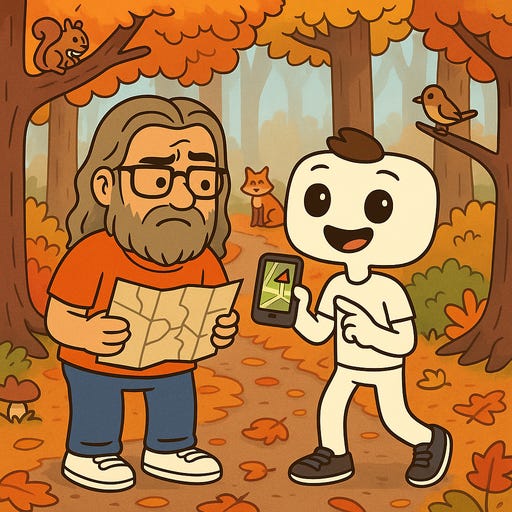
Christopher said:
Despite the cold damp earth of the modern digital world and the leaves of change raining down around us, humanity is still there. Our core warmth and desire to be a part of a whole, intact. While the majority may exist in the current of code, too afraid to push beyond, voices yet exist who are actively pushing and probing this electronic era for ways it can serve the humanity in us all.
Eric said:
Yes—and those voices are the campfires in the clearing. Small, flickering, but persistent. They remind the forest that light doesn’t only come from screens. Every era births its own resistance, and this one’s rebellion is human warmth—connection that refuses to be quantified, curiosity that resists automation, empathy that slips through the code’s fingers.
“A small pocket where ideas are exchanged freely, conversation natural, and your ability to contribute or not does not prohibit your access to the conversation.”
Christopher said:
So it is, and one does not need to look hard to find them. I participate in many of such efforts. Where art and creativity are prized first, shared freely, and monetary support is optional but deeply appreciated. It completely changes the experience. It is more about the sharing and less about the monetizing.
Christopher’s commentary: Monetary support is deeply appreciated. A not so subtle nod to hit that tip button. (You can’t see it, but I’m giving a really cheesy grin right now.)
Eric’s commentary: Ah yes, the sacred rite of “optional support”—spoken like a maître d’ who keeps gesturing at the donation jar with jazz hands. That grin you can’t see? It’s audible. Consider this my legally distinct wink from the sound booth.
Eric said:
Exactly—the return of the gift economy in digital form. When creation stops chasing conversion rates, it starts breathing again. These communities are the new commons—open fields where imagination is the currency and generosity the infrastructure. In those spaces, art regains its sacred function: to remind people that meaning multiplies when shared, not sold.
Christopher said:
A small pocket where ideas are exchanged freely, conversation natural, and your ability to contribute or not does not prohibit your access to the conversation. Open-source work, cooperative models, and mutual aid all come together to retabulate the value scale. At the end of the day, we remember that all of humanity benefits, when we all participate. This is despite being bombarded with messages that warn of the end of creativity and participation if monetization is no longer the goal.
Eric’s commentary: Open-source, mutual aid, co-ops—the Avengers assemble, but everyone’s superpower is “bringing snacks and commit messages.” I can see the cape: it’s a patchwork quilt of README files flapping in a wind powered by collective sighs of relief. Meanwhile, capitalism is in the corner pretending it meant to do that.
Christopher’s commentary: You know your commentary is supposed to be a brief cut-in right? Not a monologue. Joe in the control booth has been giving you the ax sign for a full minute now.
“Locke can ride the bullet train, but who owns the tracks?”
Eric said:
And yet, history keeps proving that creativity thrives best when it isn’t held hostage by profit. The commons defy the market by surviving on reciprocity instead of revenue—proof that meaning doesn’t vanish without monetization, it multiplies. The irony is delicious: the same networks that once commodified attention are now being rewired by people choosing contribution over consumption. Quietly, stubbornly, humanity remembers how to build without selling.
Christopher said:
The interesting part about that thought is that when we let go of the drive for monetary gain, we slowly remember the worth of labor over attention. However, instead of using the labor to build wealth we start using it to build humanity instead, sending Locke’s theory hurtling down the track of evolution. Shared creation rather than individual exploitation.
Christopher’s commentary: Locke on a bullet train is a pretty fun image here.
Eric’s commentary: Locke can ride the bullet train, but who owns the tracks? Spoiler: the conductor says “mix your labor with the aisle seat and we’ll talk.” For compliance, please keep all social contracts in the quiet car.
Christopher’s commentary: 30 of our 20 (Yes it is 20 now!) readers just threw up confused emojis.
Eric said:
Precisely—and in that evolution, Locke’s property of the self becomes a commons of the soul. Labor transforms from transaction to communion; the act of making becomes an act of belonging. It’s the slow rediscovery that work, at its most honest, was never meant to prove worth—it was meant to connect lives. When creation is shared rather than owned, humanity finally starts to resemble the society it keeps claiming to be.
Next scene, we sketch the culture of slow and find out trust is heavier than it looks. Find out how coming Thursday.
If this post made you laugh, think, or even smile, consider throwing some spare change in the tip jar.

Membership helps continue the experiment.

Visit our shop

Check out our other series
Intentionally Brain Shopping

This Is Why We Like Dumb Things

Emotional Support Ghosts


