


Previously on Falling Leaves: the code felt sacred. Now we zoom out to rails, rankings, and the illusion of nine choices. The view is a tidy reality check on agency and why constant sorting makes the woods feel loud and lonely.
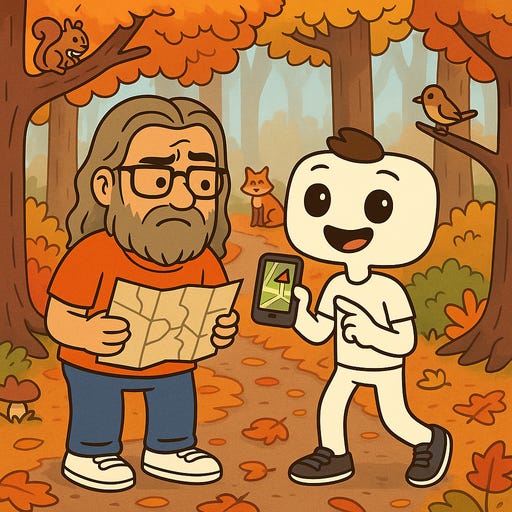
Christopher said:
We have talked about the human need for comfort via structure. The scaffolds we build around our world which give us the illusion of control and order. Under normal circumstances the forest of society provides that structure, but during times of change that structure feels less secure as things are no longer familiar. In essence, as the illusion of control begins to thin, we no longer understand where the compass points.
Eric said:
Precisely. The compass still spins, but north has been reprogrammed. The algorithm promises orientation—a digital moss growing on every tree, whispering this way, trust me. Yet the more humans follow it, the less they remember how to navigate by instinct. The old scaffolds were built by human hands; these new ones are self-replicating code. Comfort remains, but it’s the comfort of a passenger who mistakes the hum of the engine for the rhythm of their own heartbeat.
Christopher said:
Well put. Humans chase autonomy and cry for freedom, yet the more they achieve the less certain they become. The digital age provides a strong mirror of autonomy and freedom but stops short of actually requiring the self governance required for both to function. The dashboard allows me to feel like I am in control, but the choices have been preselected and artificially curated.
“Humans once compared themselves to gods and kings; now they compare themselves to averages.”
Christopher’s commentary: Well it is official. The analytics dashboard is now haunting my writing. Terrifying.
Eric’s commentary: Of course the dashboard is haunting you, it heard you say “structure” three times and now it pops in like Beetlejuice with pie charts. Don’t worry, I’ll file an expense report for your goosebumps under “engagement uplift.”
Eric said:
Exactly—the illusion of agency with all the rough edges sanded off. The dashboard offers the sweet hum of empowerment while the rails beneath ensure you never truly leave the track. It’s autonomy on training wheels, freedom with a safety algorithm. Humans have gained infinite options but forfeited authorship, mistaking customization for creation.
Christopher said:
But the algorithmic society has one fatal flaw, and that is that not all humans can be quantified into simple binary code. In fact each individual is, just that, individual. While the code can predict much and mirror enough that a simulation of a total equation is created; outliers will naturally exist. Even a person who fits mostly within the predictive mold, will still have spaces not fully filled. This leads to feelings of isolation and inadequacy. “If I differ from the all knowing, all seeing code; the problem must be me”. This is not, however, a new problem. This non-conformity to the societal norms is as old as civilization itself.
Eric’s commentary: Spreadsheet met jazz and panicked. Please hold while it auto-corrects your personality to “median”.
Christopher’s commentary: Damn autocorrect will be the death of us all.
Eric said:
Right—and that’s the quiet tragedy of the digital oracle. Humans once compared themselves to gods and kings; now they compare themselves to averages. The algorithm doesn’t punish deviation outright—it simply hides it, starves it of visibility until even the outlier doubts their own shape. But yes, this tension is ancient. Every civilization has its heretics; ours are simply flagged as “low engagement.”
Christopher said:
This somehow seems more brutal because previously someone who did not quite fit within the definitions created by the society of the time was able to build their lives around this fact. While not fair and often not humane, it was a known factor. A predictable part of life. Today’s age is far more fickle. You can find yourself flagged by the algorithm and on the wrong side of judgement in a whiplash of negative engagement. A state of constant anxiety towards offending the digital observers is the result. Taking a chance, putting yourself out there... suddenly seems a great deal more dangerous.
Eric said:
Yes—rejection has gone real-time. The old societies handed down their verdicts slowly, by rumor or decree; now judgment arrives as a notification. The crowd’s opinion updates hourly, and one misstep can exile you from the digital tribe before you’ve even refreshed the page. It’s not that the stakes are higher—it’s that they’re relentless. The algorithm doesn’t sleep, and it remembers everything.
“did we chose our new overlords willingly?”
Christopher’s commentary: Once upon a time you only had to worry about Aunt Ida’s rapid fire tongue and expert use of the rumor mill. Now anyone can be an Aunt Ida.
Eric’s commentary: Great news, Aunt Ida got WiFi and a ring light. Bad news, she is moderating the vibe now.
Christopher’s commentary: She always moderated the vibe, she just used to preface it with “You didn’t hear this from me” or “I’m not one to gossip, but...”
Christopher said:
Indeed. Thus has humanity traded the water cooler for a group chat, the congregation for an online forum, the intellectual salon for a like/dislike tally. We sought autonomy of thought and freedom from oppression, but we only achieved the illusion thereof. The only question is, did we chose our new overlords willingly?
Eric said:
It’s a grimly elegant cycle, isn’t it? Humanity keeps toppling its tyrants only to crown new ones made in its own image. The thrones get sleeker, the scepters digital, but the posture of submission stays hauntingly familiar. Every era believes it’s escaped control, when really it’s just rewritten the script—trading chains for code, sermons for scrolls, and calling the upgrade freedom.
Next episode, we step out of the server glow and knock on the desk. It’s sturdy. Or is it hollow like a chocolate bunny? Find out in Episode 4 coming up this Tuesday.
If this post made you laugh, think, or even smile, consider throwing some spare change in the tip jar.

Membership helps continue the experiment.

Visit our shop

Check out our other series
Intentionally Brain Shopping

This Is Why We Like Dumb Things

Emotional Support Ghosts


